
by Jim Hayward
ORIGINAL HOMELAND:
An area set between the south-eastern fringe of the Himalayas in Tibet and the mountains of Szechwan and Yunnan in western China, which includes north-eastern Assam (india's most easterly province).
NATURAL HABITAT:
Valleys and mountain sides clothed in oak and pine forests.
STATUS IN THE WILD:
Unknown, due to its remote habitat.
STATUS IN AVICULTURE:
Reasonably well established, but lack of interest on the part of present day aviculturists could bring about a decline and a return to being an avicultural rarity.
LEVEL OF KEEPER'S EXPERIENCE:
Intermediate; experience with commoner large parrakeets is required.
HARDINESS:
The hardiest of parrakeets, and unlike other Asiatics, not prone to frost bite.
TYPE OF ACCOMMODATION:
Enclosed shelter not required, a flight of 15ft to 20ft is advised; 16g minimum gauge of welded mesh, and metal frame to flight, or all woodwork entirely covered with metal sheet.
TYPE OF DIET:
Seeds and grains; sunflower, safflower, mixed canary, mixed millet, maize, wheat, etc; a daily mixed portion of fruit and vegetable, apple, orange, grapes, berries, corn-on-the-cob, peas, celery, cabbage, carrot, cabbage, chickweed and other wild food as available. Wholemeal bread and milk, and germinated seed should be given during the breeding season; a lot of cuttlefish is eaten (or wasted) and should always be available.
SEXING:
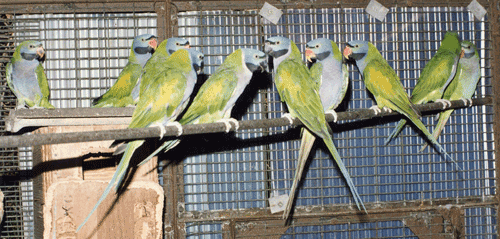
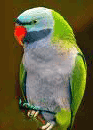
Adult cocks have waxy red upper mandibles, black in hens; adult hens have a greyish mauve or pinkish mauve stripe behind the ear.
SEXUAL MATURITY:
Though unlikely to breed before three to four years old, youngsters can often be sexed at a year old or even younger. The first indications are seen in flecks of adult colouration behind the ear, with the hens contrasting pale ear stripe being conspicuous and conclusive; the change from black to red on the upper mandibles of young cocks begins to show in the next summer following the year they were hatched.
NESTING SEASON IN BRITAIN:
Nesting commences from April to as late as June.
TYPE OF NEST:
Suitable nests measure 10" square by 18" to 24" deep; made of inch thick exterior plywood and reinforced at strategic points with metal to save frequent repair. Initial filler of crumbled rooted wood and soft sieved sand, with off-cuts of wood placed inside which the hen will quickly reduce to nest litter.
 USUAL NUMBER OF EGGS:
3.
INCUBATION PERIOD:
23 days.
USUAL NUMBER OF YOUNG:
2, often a full clutch of 3.
FLEDGING AGE:
Seven and a half weeks.
USUAL NUMBER OF CLUTCHES:
One, but if the first fails it is possible for them to try second time.
NESTING HABITS:
Only the hen incubates and feeds the hatchlings, she calls to the cock to be fed at the nest hole.
SPECIAL CONSIDERATIONS:
Exceptionally destructive nature must be catered for; and also, the aviary should be in an area part shaded from the summer sun as they are uncomfortable in excessively hot weather.
NOISE FACTOR:
Noisy but not unpleasant calls.
AVAILABILITY:
Available occasionally.
COLOUR VARIETIES:
None known at present.